Posts

Transported to Virginia

Image
Before I return to the story of the Hurt family, one of whose descendants married into the Reagan family, I want to share a link to a YouTube video concerning Pocahontas. The producers provide some background to Pocahontas' story and then attempt to show what her appearance might actually look like if you saw her in life, based on the picture that accompanied last week's post. You can find it here:  The True Face of Pocahontas?   Now back to the Hurts, none of whom would have ever known Pocahontas, as they came to Virginia after her death.  Stephen Hamlin (also spelled Hamelin or Hamlyn) brought the Hurt family to Virginia as part of a group of 25 immigrants. Hamlin and his brothers had come to Massachusetts about 15 years before, with one brother settling in Boston and the other going to Mexico. Steven obtained a land patent in Virginia two years later.  To obtain a patent a colonist generally had to provide some sort of service to a government official, such as a r...

A long road to recognition

Image
We learned about the Pamunkey tribe in the last post and how they obtained treaties with the English that were designed to protect them, their homelands and their way of life while amicably providing the English land on which they could settle. This would eventually end in the settlers deciding the tribe didn't really have the rights they thought they had allowing the settlers to take land away from the tribe and give it to members of the English community, which included one of Sharon's ancestors. Given this plain description, you might get the idea that the English dealt rather faithlessly with the Pamunkeys, and you wouldn't be entirely wrong. But we have to remember that the Europeans and Native Americans held differing views on land ownership. To the Pamunkey and the other tribes of Virginia at the time, the land they claimed belonged to the group, not the individual. Heads of families were granted the use of a plot of land by the chief and the tribal council. They had...

Just whose land was it?

Image
Time to switch back to the Reagan side of the family tree, though the connection will still be to Colonial America.  I want to emphasize that I am not claiming in any of these posts that either side of the family was part of the original communities we learn about in secondary school history classes -- Jamestown, Plymouth, the Massachusetts Bay Colony. No, the various American colonies were pretty well established by the time our family's folks started to showing up.  I'd also point out that when we think about the early days of colonization, I know that I tend to think almost exclusively in terms of the English colonies. I'm apt to forget that other nations had quite a head start on establishing outposts in what would come to be the United States, most notably Spain. And of course, we shouldn't forget that pretty much everywhere Europeans dropped in, even as far back as the Norsemen, aka Vikings, people already lived here. Which leads us into today's tale. I had tr...

Pilgrim or Puritan, or both?

Image
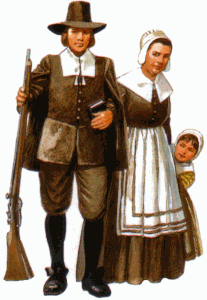
I don't know about you, but over the years since my secondary schooling, I came to create a distinction between the Pilgrims and the Puritans based pretty much on one thing -- when they arrived in the New World. I knew both were involved in the quest for religious liberty but couldn't tell you much about their religious backgrounds and how much difference, if any, in their theological stances. In fact, even after pursuing a good deal of reading in the history of Christianity in seminary and after, I never paid much attention to those two groups. I've found that many folks probably think the two are basically the same. I read in one source that Ronald Reagan (or his speechwriters) mixed them in one of his orations, calling John Winthrop a Pilgrim, though he was a Puritan leader who came to this country ten years after the Pilgrims.  My chronological  arrangement is somewhat sound. That first group of immigrants who landed in the wrong place and stayed (they had intended to g...

Come sail away -- again

Image
William Bradford's description of the Mayflower's  voyage gives a clear sense that life aboard ship was unpleasant at best. In the last post, I augmented that description a little, drawing on accounts of life aboard naval vessels in the 18th and 19th centuries and novels of naval life from that period. You can be sure life wasn't easier in the 1600s. While searching for information about Atlantic crossings involving immigrants, I found an account by Gottlieb Mittleberger of his travel to America in 1750, 130 years after the Mayflower crossing. Mittleberger had been hired to be the organist and schoolmaster at the St. Augustine's Church in Providence. I don't know if that's supposed to be the city in Rhode Island.  He would take an organ with him, which he picked up in Heilbronn in southwestern Germany, not far from Stuttgart. From there he sailed to Rotterdam, the Netherlands and thence to Cowes in England. From Cowes, he sailed aboard the Osgood with 400 other...

Come sail away with me

Image
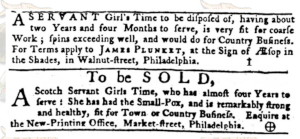
For the next couple of weeks, we will depart from my family's ancestors and their link to the times they lived in and spend some time dealing solely in history.  As previously noted many of our ancestors came to America as part of the original settlement of the country. They had exactly one choice of transportation for at least a couple of hundreds years for making the voyage -- sailing ships.  Now, maybe you've taken a cruise at some point, or you've seen a movie or television show that involves cruise ships. Maybe you've seen one of the movies about the Titanic and are aware that the ships making the Atlantic crossing and carrying immigrant passengers were divided into classes, with the passengers who could least afford the trip placed in steerage.  You might think that those sparse cabins that lacked any but the most basic of amenities might be somewhat similar to the conditions our ancestors faced when immigrating to the New World. If so, put those thoughts complete...

Is he is, or is he ain't

Image
I became excited while tracing another branch of the family tree back until it ended. William Sabin, one of Orpha Morse's (she whose line provides most of the best stories on my side), was the first of one particular families of Sabins to come to America, and one of the descriptions I ran across said he was a cofounder of one of the earliest settlements in Massachusetts, a part of the Plymouth Colony.  All my other relatives to this point settled in the Massachusetts Bay Colony, and the highest distinction I had found was that one of them had been a town's first town clerk, in part because he had good handwriting.  Sabin was cited in a Wikipedia article has having founded the town of Rehoboth, Mass., with man named Walter Palmer. Huzzah! Now, I know you may be groaning about citing a Wikipedia article, and you have a right to be. But Wiki-p articles can come in handy as a starting place for research, especially if they provide citations. This article cited the town's web pa...